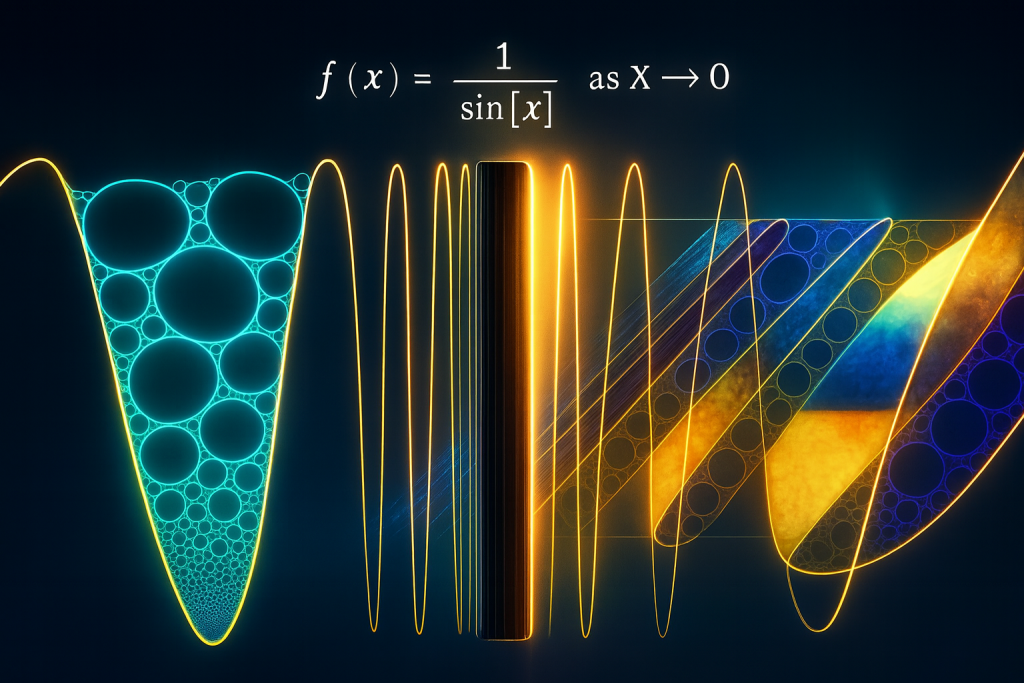
An oscillating wave of energy passing through the undefined
How intriguing it is to consider, on a metaphysical level, the concept of our own dying. Jean-Paul Sartre, the 20th-century existentialist, famously argued that death is fundamentally unintelligible—a rupture in meaning that collapses the narrative of the self. For Sartre, death is the moment where consciousness dissolves into nothingness, a point beyond which no philosophical system can truly reach.
Yet in the 21st century, developments in physics—particularly quantum theory—complicate this conclusion. Instead of pointing toward nothingness, modern physics suggests an extraordinarily dynamic transition.
Quantum theory describes an electron not as a tiny marble orbiting an atom, but as a probability cloud—an oscillating field of potential energy. As energy accumulates, the electron suddenly moves into a higher energy state, a shift determined by Planck’s constant. This energy change is related to light, which itself is not a “particle of light” in the classical sense, but a quantized electromagnetic oscillation. In fact, what we call “particles” are better understood as excitations of underlying fields rather than tiny solid bits of matter.
The energy of a photon is given by E = hν, where the frequency of the electromagnetic oscillation is multiplied by Planck’s constant. Similar in concept to Einstein’s equation E = mc², this formula suggests that reality—at its deepest level—is composed of oscillating electromagnetic energy. In this sense, evaluating our lives in terms of oscillating electromagnetic energy brings us closer to the actual structure of the universe.
E=hv energy is proportional to the wave length of light
E=mc² energy is proportional to the speed of light squared
Now, let us relate this framework to the concept of dying. Our lives are composed of countless electromagnetic interactions. The eyes provide a perfect example: light strikes the cornea and is transferred to the retina as oscillating electromagnetic energy of varying wavelengths. The brain itself is a resonating, interacting electromagnetic system—an intricate pattern of oscillations that generates what we commonly think of as consciousness, identity, and perhaps even what we call the “soul.”
Consequently, as we gather the threads of our lived experience, such as our fellowship with one another, the lives we nurture, the legacies we weave, and the moments when we contemplate our own departure, the essence of who we are leaves an unmistakable trace, an ever-unfolding oscillation of light and energy that ripples across the world. When our lives fall away, the imprint does not dissolve into nothingness. Instead, as the metaphysics of light suggests, the sum of our lived resonance swells toward a luminous crest, carrying us beyond the borders of this familiar existence and into something new, something eternal, something shaped by the deepest contours of our inner being.
Genesis chapter 1 verses 1 to 3: In the beginning God created the heavens and the earth. The earth was formless and void, and darkness was over the surface of the deep, and the Spirit of God was moving over the surface of the waters. Then God said, “Let there be light”; and there was light.